A Maharashtrian wedding is not just a ceremony; it is a fast-paced, vibrantly colorful, and deeply spiritual celebration of two families merging into one. From the soul-stirring verses of the Mangalashtak to the chaotic, joyous energy of the Halad, these celebrations are defined by fleeting, highly emotional micro-moments.
However, capturing the true essence of a Maharashtrian Lagna requires far more than just a good camera—it requires profound cultural anticipation. If a photographer doesn’t know the exact split-second the Antarpat is going to drop, or how to properly light the intricate gold zari work of a Nauvari saree without blowing out the highlights, those once-in-a-lifetime memories are lost forever.
That is exactly why mastering Marathi wedding rituals photography is an art form in itself. Whether we are shooting a high-energy traditional celebration in the heart of Mumbai or an intimate, culturally rich ceremony down in Pune, our approach goes beyond standard portraiture. We document the unscripted legacy of your family.
In this comprehensive guide, we are pulling back the curtain on how a candid Maharashtrian wedding photographer anticipates, lights, and flawlessly captures the most critical rituals of your big day.
Capturing the Pre-Wedding Anticipation
The energy of a Maharashtrian wedding doesn’t start at the mandap; it begins days—sometimes weeks—in advance. For a photographer, these pre-wedding rituals are pure gold. They are your proving ground. These intimate gatherings allow you to build a crucial rapport with the couple, map out the inner family dynamics, and capture the raw, unscripted anticipation before the fast-paced timeline of the actual wedding day takes over.
Sakharpuda (The Engagement)
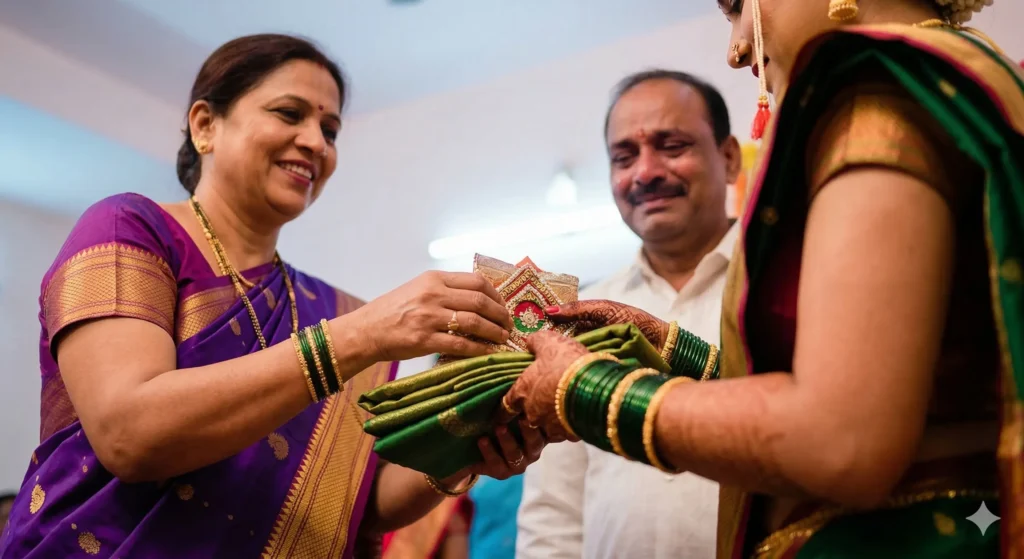
The Sakharpuda is the official seal of the union, and culturally, it carries immense emotional weight. While modern couples (and many novice photographers) focus entirely on the ring exchange, the true soul of this ceremony lies in its namesake: the offering of the sugar packet (sakhar puda) and the traditional sari.
From an experienced shooting perspective, the ring exchange is easy to capture because it is choreographed. The sugar packet exchange, however, is fluid and heavily involves the elders. It is a moment of deep, quiet respect. When I shoot a Sakharpuda, I always position my primary camera to focus on the intricate details of the hands exchanging the offerings, while ensuring a second angle is locked firmly on the parents. The candid, teary-eyed smile of a mother or the proud nod of a father during this exchange is often the most valuable image of the entire day. You aren’t just photographing an event; you are documenting the merging of two family trees.
Read Next : How to Choose the Best Pre Wedding Package in Mumbai
Kelvan & Halad Chadavane
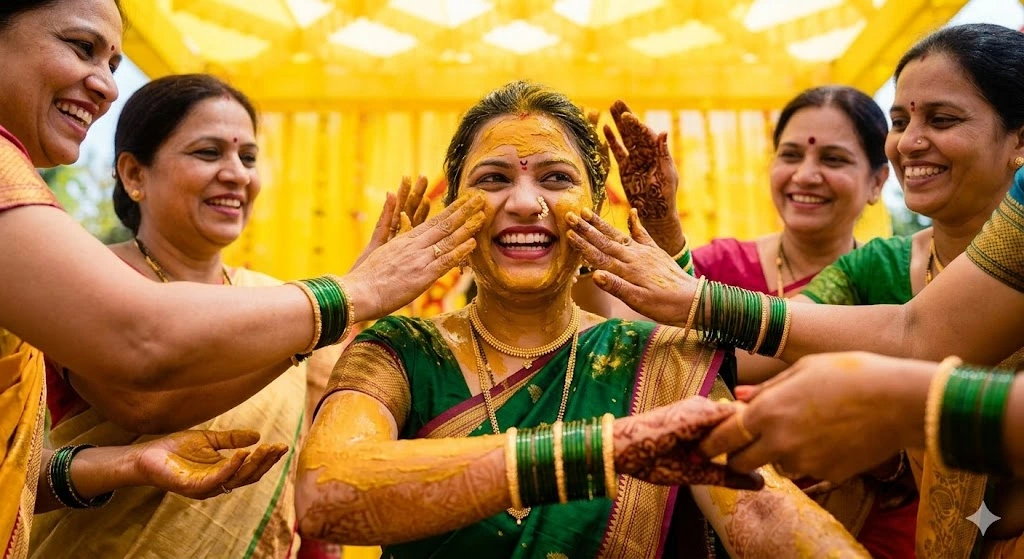
If the Sakharpuda is formal, the Kelvan (traditional family feasts) and the Halad Chadavane (the turmeric ceremony) are where the families finally let loose. This is pure, chaotic joy.
However, from a technical standpoint, shooting the Halad is notoriously difficult. Wet turmeric is highly reflective. When you combine vibrant yellow paste with bright Indian sunlight or harsh indoor halogens, it acts as a massive color reflector, throwing a heavy yellow tint onto the skin and easily blowing out your highlights. To combat this, I always shoot slightly underexposed to protect those bright highlights and strictly use a custom white balance. If the event is indoors, carefully bouncing an off-camera flash off a neutral surface is critical to cut through the color cast and preserve natural skin tones.
Once your lighting is dialed in, you have to get right into the middle of the beautiful mess. You want the wide, action-packed shots of extended family members playfully attacking the groom, but you also need to isolate the quieter, emotional crops.
A deeply poignant visual transition happens around this time when the couple dons the Mundawali (the sacred pearl or flower strings tied across the forehead). Capturing the striking contrast of the pristine, delicate Mundawali framing their faces against skin stained with vibrant yellow turmeric is a must-have shot. It creates a powerful, culturally rich portrait that instantly screams “Maharashtrian Wedding” and beautifully signifies their readiness to step into the mandap.
Wedding Day (Lagna) Rituals
The actual Lagna (wedding ceremony) is where your technical agility is tested to its absolute limits. Maharashtrian weddings are beautifully fast-paced. The rituals flow from one into the next with very little downtime, and there are no “retakes.” To successfully photograph the Lagna, you must anticipate the cultural beats before they happen, ensuring your lighting and positioning are dialed in well before the priest signals the next step.
Gaurihar Puja & The Bridal Portrait
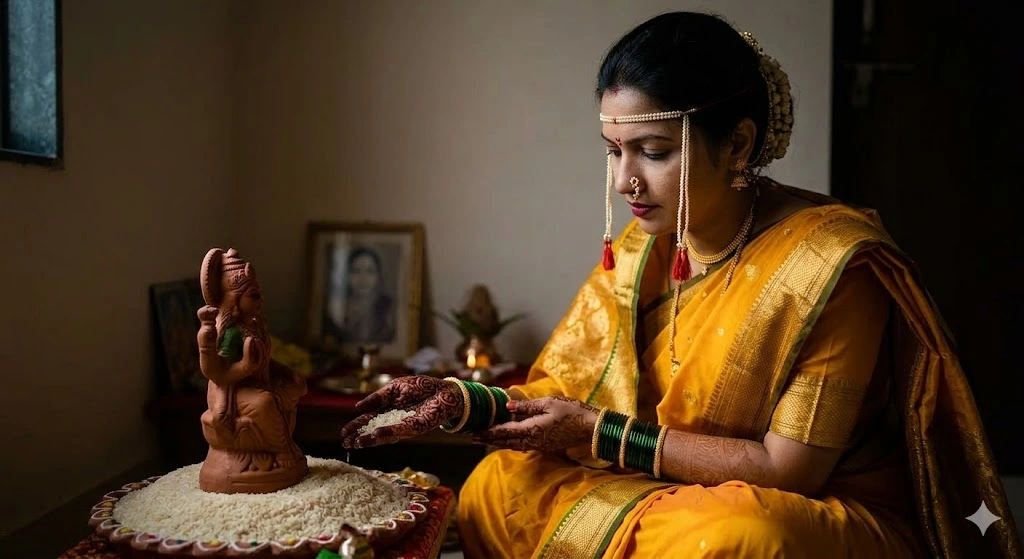
Before the bride even approaches the mandap, she performs the Gaurihar Puja, worshipping an idol of Goddess Parvati placed on a mound of rice. This is a deeply quiet, introspective moment, but from a photographer’s perspective, it is often held in a cramped room with mixed, unflattering ambient lighting.
This is the prime window for your classic, traditional bridal portraits. Her makeup is flawless, her traditional green glass bangles (Chooda) are gleaming, and the Mundavalya is perfectly set. Because room lighting is often unpredictable here, I never rely on it. My go-to setup is a single, off-camera flash modified with a softbox, positioned at a 45-degree angle to mimic soft window light. This directional lighting sculpts the face, highlights the intricate textures of the Nauvari or Paithani saree, and creates a beautiful catchlight in her eyes as she looks down at the deity. Capturing the intense focus and devotion in her eyes right now provides a breathtaking contrast to the joyful chaos that follows.
The Antarpat and Mangalashtak (The Critical Shot)
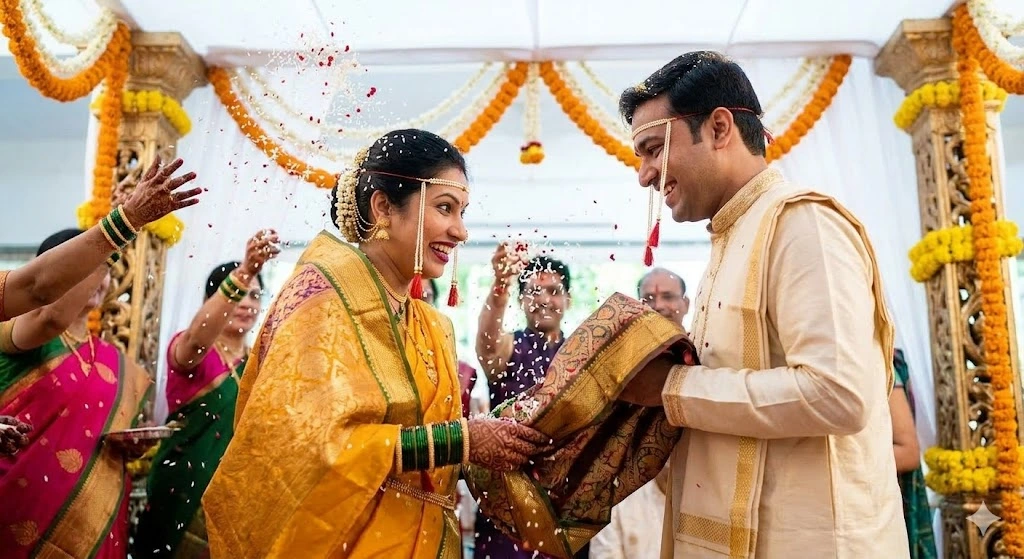
If there is one “make or break” moment in a Marathi wedding, it is the dropping of the Antarpat (the silk shawl separating the couple). As the priest and guests chant the final verses of the Mangalashtak, the anticipation in the room peaks. The absolute second the shawl drops, guests shower the couple with Akshata (sacred rice).
You have less than two seconds to nail this. If you miss it, the moment is gone forever.
This requires a strict two-shooter strategy. As the lead photographer, I position myself dead center, crouching slightly low with a wide-to-medium lens (like a 24-70mm). This angle ensures I capture the shawl dropping, the faces of both the bride and groom, and the cinematic flurry of rice raining down from the guests. The second shooter must be positioned off to the side with a telephoto lens (typically a 70-200mm), locked tightly onto the groom’s face to capture his raw, split-second reaction to seeing his bride.
Your camera settings here are critical: you must be on continuous high-speed shooting (burst mode) with a shutter speed of at least 1/500th of a second. Anything slower, and the flying Akshata will turn into distracting, blurry streaks across the couple’s faces.
Kanyadaan, Saptapadi, and Karmasamapti
Following the emotional weight of the Kanyadaan (giving away of the bride), the couple moves to the Saptapadi (the seven steps around the holy fire). Photographing around a live fire presents a unique technical hurdle. The flames act as an unpredictable, warm light source from below, which can create harsh, unflattering “campfire” shadows on the couple’s faces if you aren’t careful.
To handle the fire’s glow naturally, you must expose for the couple’s skin, not the bright flames. I prefer using a fast prime lens (like a 35mm or 50mm f/1.4) to let in as much ambient light as possible. If the mandap is too dark and flash is necessary, I strictly use a CTO (Color Temperature Orange) gel on my flash. This warms up the artificial light so it perfectly blends with the golden glow of the Havan (fire), maintaining the sacred, warm ambiance of the ritual.
During the seven steps, movement is key. I stay highly mobile, shooting from a low angle to capture the intricate details of the bride’s feet taking the steps near the fire, before panning up to capture the solemnity on their faces as they whisper their vows, leading beautifully into the Karmasamapti (conclusion of the ceremony).
Post-Wedding Emotions: Varat and Grihapravesh
As a photographer, the emotional whiplash of the post-wedding rituals is where your storytelling truly comes alive. The adrenaline of the Lagna begins to settle, making way for some of the most raw, unfiltered moments of the entire celebration. Navigating the shift from the heartbreaking farewell to the warm, auspicious welcome requires extreme empathy and a rapid adjustment of your camera settings.
The Varat and Pathavani (The Farewell)
In Maharashtrian culture, the Varat is the energetic procession where the groom takes his bride home, often accompanied by booming dhol-tasha and dancing family members. Yet, running parallel to this high-energy celebration is the Pathavani (the Bidai)—the deeply emotional moment the bride bids farewell to her maternal home and parents.
Visually, this contrast is staggering. You have the jubilant groom’s side celebrating outside, while inside, the bride and her parents share tearful, private goodbyes. My approach here is entirely photojournalistic. I switch to a longer focal length—usually an 85mm or a 70-200mm lens. Stepping back and giving the family physical space to breathe and cry without a camera shoved in their faces is not just polite; it results in far more authentic, heart-wrenching imagery. Because this often happens in the late afternoon or evening fading light, I rely heavily on the wide aperture of my prime lenses to isolate the bride’s tear-stained face against the blurred background of the bustling crowd, capturing the exact gravity of her transition.
The Grihapravesh (The Welcoming)
The tone shifts dramatically once the procession reaches the groom’s home. The sorrow of the Pathavani dissolves into the warmth of the Grihapravesh. The groom’s mother welcomes the couple with an Aarti, washing their feet and preparing for the bride’s auspicious entry as the embodiment of Goddess Lakshmi.
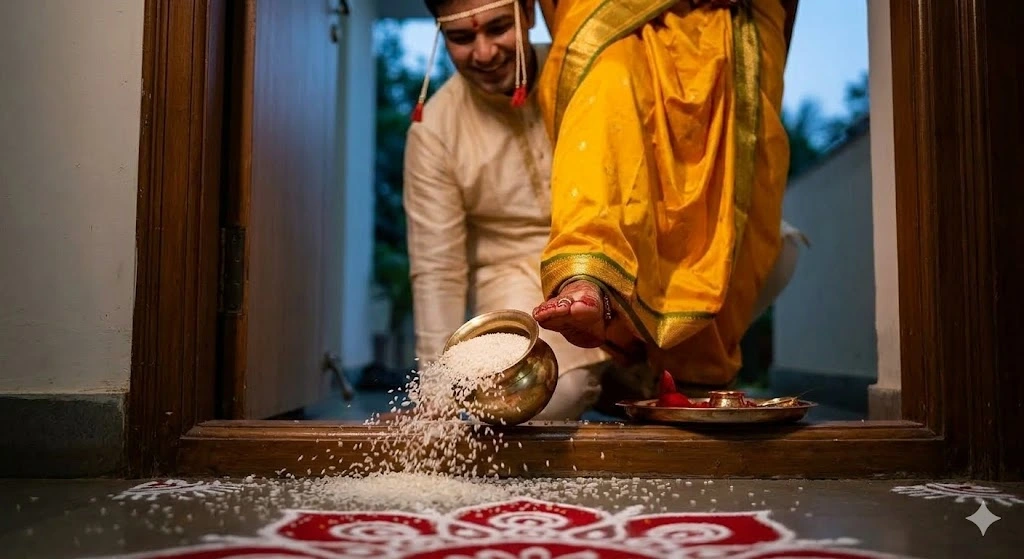
The climax of this ritual is the Map Olandane—when the bride gently kicks over a Kalash (a brass measuring pot) completely overflowing with rice, spilling it inward across the threshold before stepping into a thali of red Kumkum water to leave her footprints (Laxmi Pavle) on the floor.
This is a high-pressure, single-take shot that usually happens in a cramped doorway with tricky, mixed lighting (warm indoor bulbs clashing with outdoor ambient light). To nail this, I immediately drop low to the ground. Getting a low angle is non-negotiable here. I pre-focus my lens specifically on the Kalash and bump my shutter speed up to at least 1/400th of a second. You want to freeze the exact split-second the brass pot tips and the individual grains of white rice scatter across the floor.
Final Thoughts
A Maharashtrian wedding is a beautiful whirlwind of emotions, vibrant colors, and sacred traditions. As we’ve explored, capturing this fast-paced celebration requires far more than just clicking a shutter. It demands a deep understanding of the culture, the technical agility to adapt to mixed lighting in a split second, and the empathy to document both the joyous chaos and the quiet, tearful goodbyes.
Mastering Marathi wedding rituals photography is about anticipating the unscripted moments before they happen—the exact second the Antarpat drops, the glowing warmth of the Halad, and the emotional weight of the Grihapravesh. When you look back at your wedding album decades from now, you shouldn’t just see what happened; you should feel exactly what it felt like to be standing there in the mandap.
By choosing a photography team that understands the true soul of these traditions, you ensure that the vibrant, unscripted legacy of your family is flawlessly preserved for generations to come.
Planning a traditional Marathi wedding in the city? From the quiet devotion of the Gaurihar Puja to the chaotic joy of the Grihapravesh, trust a photography team that understands the cultural heartbeat of every single ritual. [Book the best Wedding Photography in Mumbai with Ollar Studios] to secure your dates today.