Indian businesses have a rare window right now. Podcasting delivers brand authority, qualified leads, and compounding content — and in most Indian niches, your competition hasn’t started yet.
Globally, there is currently one podcast for every 1,577 people. Blogs outnumber podcasts 225 to 1[1]. That gap is your advantage. Here is exactly what podcasting does for a business, and why the opportunity is significantly bigger in India than anywhere else.
Why Business Podcasting Is Growing Faster in India Than Anywhere Else
India’s podcast market is accelerating at a pace that has no parallel in its content marketing history. The global listener base reached 584.1 million in 2025 and is projected to hit 619 million by 2026[2]. India is driving a significant portion of that growth, fuelled by surging smartphone penetration, regional language audio consumption, and a young professional class hungry for on-demand learning.
What makes this extraordinary for Indian businesses is not just the audience size — it is the competitive vacuum. Most of the 4.5 million podcasts worldwide are English-language, US or UK-centric shows. Hindi, Marathi, Tamil, and Bengali business content remains dramatically undersupplied. For a Mumbai entrepreneur, a Thane-based D2C brand, or a founder targeting mid-market Indian companies, the first-mover advantage in podcasting is not a theory — it is a measurable, exploitable reality right now.
The window will not stay open indefinitely. Start building your audio presence before your competitors even notice it exists.
Benefit 1 — It Builds Authority Faster Than Any Other Content Format
Podcasting builds brand authority faster than blogging, social media, or video because audio creates genuine psychological intimacy. When a listener hears your voice for 40 minutes during their commute or workout, they experience a parasocial relationship — they feel like they know you. That trust transfers directly to your brand.
The numbers are unambiguous. Research shows that 83% of podcast listeners trust hosts significantly more than they trust traditional digital advertisements[3]. Meanwhile, 85% of podcast listeners are highly loyal, returning for multiple episodes of shows they value. For an Indian brand navigating a trust-deficit digital environment — where consumers have been burned by low-quality content and generic influencer promotions — that credibility signal is invaluable.
And the engagement is unlike any other format. An astonishing 80% of podcast listeners consume all or most of every episode they start[4]. Compare that to the meager 12% completion rate of standard corporate video. Depth of attention, sustained over dozens of episodes, compounds into authority that no ad budget can replicate.
For Mumbai businesses specifically, being the “podcast voice” in your niche — whether that is product photography, HR consulting, D2C retail, or any other sector — means being perceived as the category leader before the market fully matures. That position is extraordinarily difficult to displace once established.
Benefit 2 — It Generates SEO Value Far Beyond the Audio File
A podcast episode is not just audio. It is a content engine disguised as a conversation.
Every 45-minute episode, when properly transcribed and structured, generates thousands of words of crawlable text that naturally contains long-tail keywords, industry terminology, and the exact phrasing Indian buyers use when searching online. That transcript becomes a blog post. The blog post earns backlinks when the guest shares the episode. Those backlinks lift your entire domain’s authority.
This matters enormously for a market like India, where content output is high but quality long-form content is scarce. A well-structured show notes page or derivative article from a podcast episode can rank for commercial keywords — “podcast studio Mumbai,” “product photography tips for e-commerce India,” “how to start a business podcast in India” — without the exhausting effort of producing keyword-stuffed blog posts from scratch.
94% of all newly published blog posts earn zero external backlinks[5]. A podcast guest who shares their episode to 5,000 LinkedIn followers solves that problem in a single share. That is leverage that text-based content cannot create on its own.
Beyond traditional SEO, there is now a more critical layer: Answer Engine Optimization (AEO). AI tools — ChatGPT, Perplexity, Google Gemini — are increasingly becoming the first stop for business research. These systems algorithmically prefer the long-form, conversational, expert-driven content structure inherent in podcast transcripts. Early adopters who structure their episodes for AI citation are already reporting conversion rates exceeding 10% from AI referral platforms. India’s AI-first professional class is growing rapidly; optimising for this channel now positions your brand in the answer engines your future customers will trust.
Benefit 3 — It Creates a Compounding Content Engine
One podcast episode, handled correctly, does not produce one piece of content. It produces dozens.
Based on documented repurposing workflows using AI tools, a single well-produced episode can generate up to 47 discrete pieces of derivative content[6]: SEO blog posts, LinkedIn carousels, short-form video clips for Instagram Reels and YouTube Shorts, email newsletters, audiograms, quote graphics, and sales enablement documents. The original recording is the master asset. Everything else is leverage.
For a lean Indian business — a studio, a consultancy, a D2C brand — this is transformative. It means one dedicated recording session per week can fuel your entire content calendar across every platform. The production cost does not scale linearly with output. You record once; you distribute everywhere.
Content repurposing also extends the lifespan of an episode far beyond its launch week. A clip from a podcast recorded in April can surface in a YouTube Shorts algorithm in August. A blog post based on a conversation can rank and generate traffic for two to three years. The compound return on a single episode is exponentially greater than the flat return of a standalone social media post.
Benefit 4 — It Builds Audience Loyalty That Other Channels Cannot Match
Loyalty from podcast listeners is categorically different from social media followers.
A person who follows you on Instagram sees your posts intermittently, between competitor ads, memes, and algorithmic surprises. A person who subscribes to your podcast is making a deliberate, recurring commitment. They have chosen to spend 40 minutes with you, repeatedly, often weekly, for months. That is not an audience — that is a community.
Research confirms this dynamic numerically. Among B2B decision-makers — the buyers, procurement heads, and founders Indian businesses are chasing — 75% are active podcast listeners[2]. A remarkable 83% of C-suite executives listen to podcasts weekly. Critically, 59% of these corporate decision-makers consume podcast content during working hours, integrating it into their professional thinking[7].
A podcast with 500 loyal, niche listeners in Mumbai converts better than 50,000 passive Instagram followers. Because the listener already trusts you before they ever fill out a contact form, the sales conversation starts several steps ahead of where it would with a cold digital lead. Trust is pre-installed.
Benefit 5 — It Opens Business Development Doors That Cold Outreach Cannot
A podcast is the most elegant business development tool available because it turns an ask into an offer.
Cold emails and LinkedIn DMs ask for something: time, a call, attention. A podcast invitation offers something: a platform, an audience, a conversation. Senior executives who delete 95% of cold outreach will accept a podcast invitation because it serves their own interests — visibility, thought leadership, a credibility signal for their own brand.
The business implications of this dynamic are striking. Industry data shows that among B2B businesses using strategic podcast guest selection, the average guest-to-client conversion rate is 10%[2]. Top-performing organisations that systematically align guest curation with their sales targets convert up to 48% of guests into active pipeline opportunities.
Deals influenced by podcast relationships close 24% to 31% faster than standard deals, because the trust and familiarity built through long-form audio removes the friction of early-stage relationship building. Average deal sizes among podcast-influenced buyers expand by 34%, as perceived authority supports premium pricing. Customer Acquisition Cost drops by 18% to 25% as the pipeline warms itself.
For a Mumbai business — a wedding photography studio, a consultancy, a tech company — systematically inviting your top 20 potential clients or referral partners onto a well-produced podcast is the most cost-efficient sales motion available. You get a one-hour conversation, a permanent content asset, and the beginning of a genuine professional relationship, all from one recording session.
Benefit 6 — It Is the Most Accessible Premium Content Format for Indian Businesses
Producing a high-quality podcast does not require the capital expenditure that high-quality video demands.
The comparative economics are stark. A 45-minute podcast episode recorded in a professional studio costs a fraction of a comparable video production. You do not need a camera crew, a lighting director, a set, or a video editor. You need a great microphone, an acoustically treated room, and something worth saying. The output — professional audio, expert content, a distributable episode — positions your brand at a premium level without premium production costs.
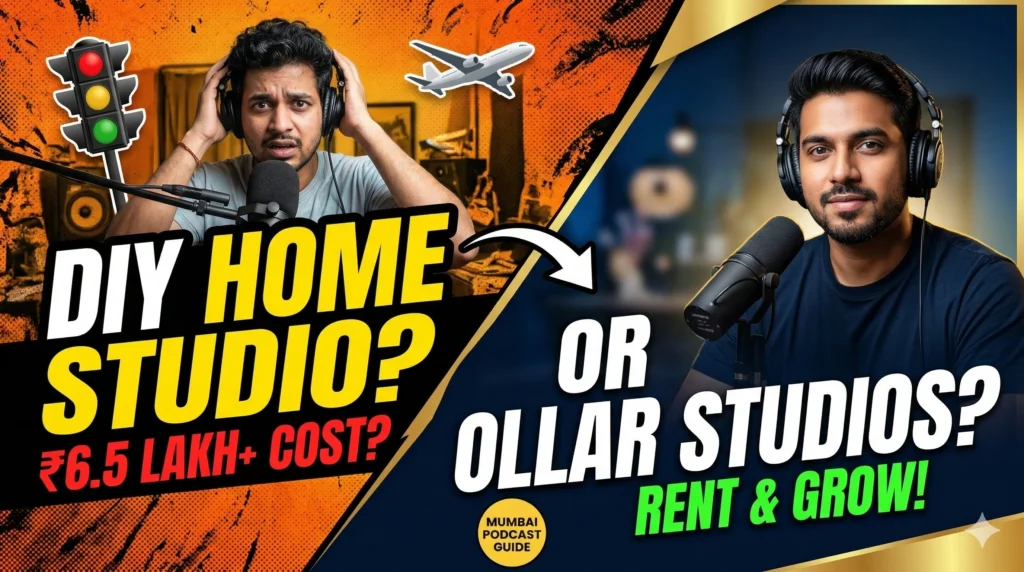
For Indian businesses in particular, renting a professional podcast studio is the most economical path to broadcast-quality audio. A professional podcast studio in Mumbai provides acoustically treated rooms, broadcast-quality microphones, recording support, and a polished setup — everything required to record an episode that sounds indistinguishable from a nationally recognised show. The cost is a fraction of building a home setup with comparable sound quality, and it eliminates the technical friction that causes most DIY podcasters to abandon their shows within the first three months.
How to Start a Business Podcast in Mumbai — Without the Setup Headaches
The single most common reason Indian business owners delay starting a podcast is the setup: equipment purchases, acoustic treatment, learning recording software, troubleshooting audio quality issues. It creates a high activation energy that delays launch by months.
The straightforward solution is to record in a professional podcast studio rather than building your own infrastructure. You arrive, you record, the room handles the sound. No equipment decisions, no acoustic panels on the walls, no microphone comparisons. The technical barrier disappears entirely.
Ollar Studios, based in Mulund (West), Mumbai, operates a fully equipped podcast production studio — acoustically treated, professionally outfitted, available for hourly booking. Whether you are recording your first episode or your fiftieth, the setup handles the technical side so you can focus entirely on the conversation. Explore the Podcast Production Studio at Ollar Studios
- If you are weighing the studio rental vs. home setup question before making a decision, read our detailed breakdown: Renting a Podcast Studio vs. Building a Home Setup in Mumbai
- For a complete understanding of what recording costs look like in Mumbai: Podcast Studio Cost in Mumbai — What to Expect
FAQ — Business Podcasting in India
Is podcasting worth it for small businesses in India?
Yes. India’s podcast listener base is growing at over 30% annually, and most niches — especially B2B and local service businesses — have almost no podcast competition. The first-mover advantage in an undersupplied market is the single most valuable SEO and brand-building asset available to a small Indian business right now. A podcast with 300 loyal listeners in your niche converts at rates that most digital advertising cannot match.
How much does it cost to start a business podcast in Mumbai?
Renting a professional podcast studio in Mumbai typically costs between ₹1,500 and ₹4,000 per hour depending on the facility and package. This covers a fully equipped recording setup with acoustic treatment, professional microphones, and recording support — significantly more cost-effective than purchasing and setting up comparable home studio equipment.
How many episodes before a business podcast starts showing results?
Most business podcasts begin generating measurable brand awareness and inbound interest between episodes 10 and 20, assuming consistent publishing and a clearly defined niche. SEO benefits from transcripts and show notes typically appear within 60 to 90 days. Relationship-based pipeline results — from strategic guest selection — can appear within the first five episodes.
What equipment do I need to start a business podcast?
At minimum: a condenser or dynamic microphone, an audio interface, closed-back headphones, and recording software. Renting a professional podcast studio eliminates all of these decisions — everything is set up and calibrated when you arrive. For most Indian business owners, this is both the faster and the smarter starting point.
Can a local Mumbai business benefit from podcasting even without a large audience?
Absolutely. A podcast with 200 loyal, niche-relevant listeners in Mumbai will generate more qualified business than 20,000 passive social media followers. For local businesses, podcast content also drives SEO value for hyper-local keywords, builds genuine relationships with guests who become clients or referral sources, and positions the founder as the go-to expert in their Mumbai market — all compounding over time.
The Bottom Line
The Indian podcast market is growing fast, competition in most niches is minimal, and the content asset you build today compounds in value for years. Every episode is a relationship, an SEO asset, a content engine, and a brand-building tool simultaneously. No other format delivers that return per hour of production time.
The businesses that start now will own the audio real estate in their categories. The businesses that wait will find that space occupied.
If you are ready to record your first episode in a professional studio in Mumbai — with everything set up and handled — book a session at Ollar Studios. Mulund (W), Mumbai. Available now.
Sources & References
- [1] Neil Patel: Podcasting vs Blogging Market Opportunity
- [2] KazCM: B2B Podcast ROI: Why Podcasting Is Business Infrastructure 2026
- [3] Foundr: Harnessing the Power of Podcasts for Brand Awareness in 2025
- [4] Elite Business: How podcasts are revolutionising sales and marketing
- [5] Digitaloft: Content Marketing Statistics You Need to Know
- [6] Goldcast: B2B Podcasting: Turn One Episode Into 20+ Content Assets
- [7] Content Allies: The ROI of B2B Podcasting